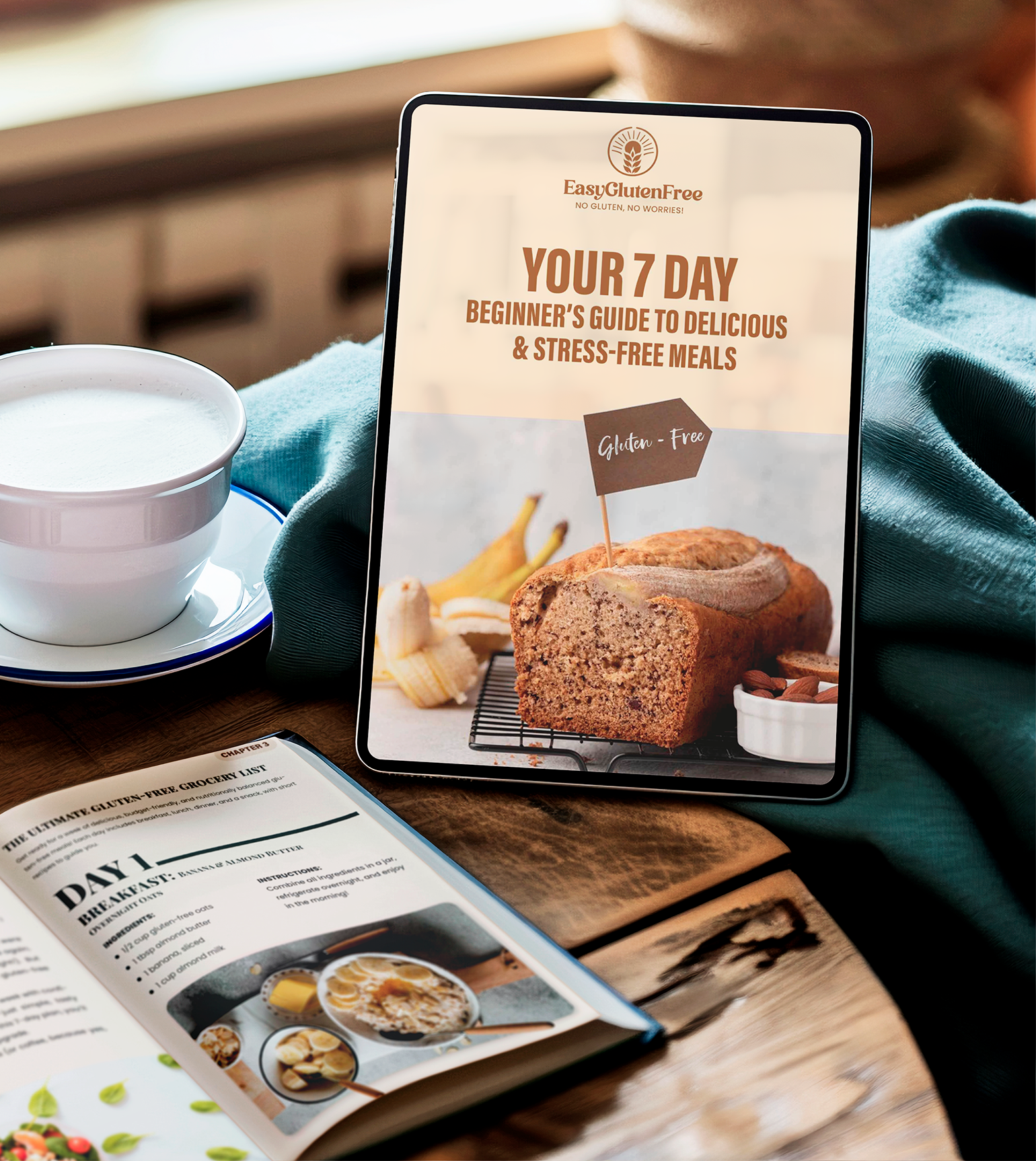
Download Your Free Guide to Confident Gluten-Free Eating Out

Gluten-Free Dining Out: How to Eat at Restaurants Without Getting Glutened
Eating out gluten free can feel like a trust fall with a stranger holding a baguette. This guide walks you through how to research restaurants, ask confident questions, and use simple tools to reduce cross-contact risk—so you can enjoy a meal out without spending the rest of the day worrying about what was really in your food.
Download Our Free Gluten-Free Starter Guide
- 7-day meal plan
- shopping list
- Tips & 3 beginner-friendly recipes
Introduction
Learning to eat out gluten free is a bit like learning a new language: at first you translate everything in your head, and eventually it becomes second nature. The goal of this article is to move you from “I have no idea what to ask” to “I know exactly how to handle this menu and this conversation” as quickly—and calmly—as possible.
We’ll walk through how to choose safer restaurants, how to talk to staff without feeling awkward, what red flags to watch for, and how to use tools like gluten test devices as one more layer of information. You’ll also get practical scripts, real-world examples, and decision checklists you can use tonight.
Whether you are strictly gluten free for medical reasons or simply feel better without gluten, this guide is designed to be evergreen: timeless principles, not just trendy restaurant hacks. Keep it bookmarked so that every time someone says, “Let’s grab dinner!” you can think, “Sure, I’ve got this,” instead of silently panicking over the bread basket.
1. Choosing Safer Gluten-Free Restaurants
The safest gluten-free restaurant meal usually starts long before you sit down at the table. A few minutes of research can drastically lower your risk of getting glutened and make the whole experience smoother.
1.1 How to research restaurants before you go
Start with a quick online scan. You’re looking for three things: clear gluten-free information, signs the restaurant understands cross-contact, and recent reviews from gluten-free diners.
- Check the menu online. Look for a separate gluten-free menu or clearly marked GF items. Bonus points if they mention a dedicated fryer or prep area.
- Scan their website or social media. Terms like “celiac safe,” “separate prep area,” or “trained staff” are useful, but still verify in person.
- Read recent reviews by gluten-free customers. Search terms like “gluten free,” “celiac,” or “allergy” in Google/Maps/Yelp reviews for real-life experiences.
If you can’t find any information about gluten-free options, that doesn’t automatically mean “no,” but it does mean you’ll need to ask more questions.
1.2 Calling ahead: what to ask in two minutes
A short phone call can tell you more in two minutes than 20 minutes of scrolling. When you call, be polite, concise, and specific about your needs.
Here’s a simple script you can adapt:
“Hi, I eat strictly gluten free for health reasons and need to avoid cross-contact, similar to a food allergy. Do you have gluten-free options that can be prepared separately?”
Then follow up with one or two key questions:
- “Do you have a separate fryer for gluten-free items?”
- “Can you cook gluten-free pasta in clean water and use separate utensils?”
- “Is there a dish you recommend that you can prepare most safely gluten free?”
Pay attention to how the staff responds. Confident, specific answers are a green flag. Hesitation, confusion, or “we can just take the bun off” are warning signs.
1.3 Green flags vs. red flags
Use this quick mental checklist when evaluating a restaurant:
Green flags:
- Separate gluten-free menu or clearly marked GF items
- Staff mentions cross-contact without you prompting
- Willingness to check labels or talk to the chef
- Clear protocols for allergies (e.g., noted in the system, different colored plates)
Red flags:
- “We’re not really sure what has gluten, but a lot of things probably don’t.”
- Only offer to remove bread or a bun without adjusting prep area
- Shared fryers used for breaded items and “gluten-free” fries
- No ingredient lists available and no willingness to ask the kitchen
You don’t need a perfect restaurant—just one that takes your needs seriously, communicates clearly, and is open to working with you.
1.4 Safer-style restaurant types to prioritize
Every city is different, but there are patterns that can guide you:
- Dedicated gluten-free restaurants or bakeries: Often the safest choices. Still confirm basics, but risk is generally much lower.
- Fast-casual places with build-your-own bowls or salads: Good if they change gloves, use separate utensils, and can access uncontaminated ingredients.
- Simple menus with whole foods: Grilled proteins, plain rice, steamed veggies, and salads (with safe dressing) are often easier to prepare safely than complex fusion dishes with many sauces.
Use these patterns as a starting point, then layer in your own research and comfort level.
2. Smart Tools & Gluten Testing on the Go
Even with great communication and careful restaurant choices, eating out gluten free can still feel uncertain. That’s where portable tools and strategies come in—they can’t replace good kitchen practices, but they can give you more data and confidence.
2.1 Why tools are a supplement, not a shortcut
It’s tempting to rely fully on a device or one simple “hack,” but tools work best as one layer in a bigger safety system:
- You still need to ask questions and communicate your needs clearly.
- You still benefit from choosing restaurants that understand gluten and cross-contact.
- You still want a personal “comfort line” for risk and stick to it.
Think of testing tools like seatbelts: incredibly helpful, but not a reason to drive with your eyes closed.
2.2 What gluten-test devices can help with
Portable gluten test systems are designed to detect the presence of gluten proteins in small food samples. Many people use them when:
- They’re trying a new restaurant and want more data.
- They’re traveling and language is a barrier.
- They’re navigating mixed kitchens (like parties or catered events).
As with any tool, it’s important to read the manufacturer’s instructions carefully, understand what the device can and cannot detect, and use it as one more input when deciding what feels safe for you.
2.3 Building a simple “eating out” toolkit
You don’t need a suitcase full of gear to eat out more comfortably. Many gluten-free diners like to keep:
- A small card explaining their gluten-free needs to hand to servers.
- Safe snacks in their bag in case the restaurant doesn’t work out.
- Optional: a gluten test device and capsules if they find that extra data helpful.
The key is to create a repeatable routine that reduces stress: research, questions, observations, and any tools that fit your lifestyle and budget.
Nima gluten sensor test
These single-use capsules pair with the Nima Sensor to help users test foods for gluten on the spot. Perfect for travelers, researchers of their own digestive reactions, or anyone who just doesn’t trust that café’s “gluten-free… we think?” answer. A reliable, quick-gluten-detection option that empowers people who want data—not guesswork.

3. How to Order: Questions, Scripts & Red Flags
Once you’ve chosen a restaurant and sat down, the way you order makes a big difference. You don’t need to be demanding, but you do need to be clear, specific, and calm.
3.1 How to explain your needs clearly
Servers and chefs hear “gluten free” for all kinds of reasons, from preferences to medical needs. Clarifying your level of strictness—without oversharing—helps them understand what’s at stake.
Try something like:
“I need my meal prepared strictly gluten free, similar to someone with a serious allergy. That means avoiding cross-contact with wheat, bread, or regular pasta. Is that something you can do?”
This sets the tone: you’re serious but reasonable, open to their suggestions, and willing to work together.
3.2 Core questions to ask your server
Not every meal requires a full interrogation, but there are a few high-impact questions you can lean on:
- “Do you have a gluten-free menu or list of gluten-free options?”
- “Are your fries (or chips) cooked in a dedicated gluten-free fryer?”
- “Could you ask the kitchen to cook this in a clean pan with clean utensils?”
- “Does this dish contain soy sauce, breading, flour, or roux?”
If something feels unclear, it’s okay to ask them to double-check with the chef. A good restaurant won’t mind.
3.3 Simple scripts for common situations
For a burger or sandwich:
“Can I have the burger with a gluten-free bun or no bun, cooked in a clean pan, and please make sure the fries are from a dedicated gluten-free fryer? If not, I’ll skip the fries.”
For pasta:
“Do you cook the gluten-free pasta in separate water with separate utensils, or is it boiled in the same water as regular pasta?”
For salads:
“Could you make this without croutons and check that the dressing is gluten free? If not, oil and vinegar is fine.”
3.4 Red flags while you’re ordering
Sometimes the warning signs only show up at the table. Consider these reasons to rethink your order—or choose somewhere else:
- Your server uses “gluten free” and “vegan” interchangeably or seems very confused.
- They insist “a little flour” or “just a dusting of breadcrumbs” is fine.
- The kitchen can’t answer basic ingredient questions.
- Your plate arrives with obvious gluten (like croutons) after you’ve explained your needs.
You’re allowed to protect your health. It’s always okay to say, “I’m not comfortable with this plate; could you please remake it, or I’ll choose something else?”
Recipe Inspiration
Try these gluten-free staples loved by thousands:



4. Cuisine-by-Cuisine Guide to Eating Out Gluten Free
Some cuisines are easier to navigate gluten free than others. While every restaurant is different, knowing typical ingredients and hidden gluten spots can help you zero in on safer choices.
4.1 Italian
Italian food can be both a challenge and a dream for gluten-free diners. Many Italian restaurants now offer gluten-free pasta and pizza bases, but cross-contact is a big consideration.
- Ask if gluten-free pasta is boiled in separate water, with separate utensils.
- Choose simple sauces like tomato, olive oil, or pesto (verify ingredients) over thick cream sauces, which may use roux.
- For pizza, ask if they have a separate prep area or if they can bake your pizza on a clean tray to reduce contact with floury surfaces.
4.2 Mexican & Latin American
Many traditional dishes are naturally gluten free, especially when made with corn instead of wheat.
- Confirm that tortillas are 100% corn, not a wheat–corn blend.
- Ask whether tortilla chips share a fryer with breaded items.
- Watch for flour in sauces, spice mixes, or breaded proteins like milanesas.
Build-your-own bowls with rice, beans, grilled meat, salsa, and guacamole can be a great, simple option.
4.3 Asian cuisines
Asian cuisines vary a lot. The biggest recurring theme to watch for is soy sauce, which is often made with wheat.
- Ask if they have gluten-free tamari or soy sauce, or if dishes can be made without it.
- Check marinades, dipping sauces, and stir-fry sauces.
- Watch for breaded items like katsu, tempura, or crispy chicken coatings.
Rice-based dishes with plain steamed rice, grilled meats, and simple sauces (confirmed gluten free) are often your best bet.
4.4 American, pubs & diners
Classic grills and diners can be surprisingly workable if the staff understands cross-contact.
- Look for grilled meats, baked potatoes, and steamed veggies.
- Ask about a dedicated fryer for fries, wings, and hash browns.
- Check burger buns, seasonings on fries, and whether pancakes or toast are cooked on the same flat top as your eggs.
Sometimes the simplest plate—like grilled chicken with rice and veg—is the safest win.
4.5 Bakeries & cafés
Bakeries can be high-risk if they use wheat flour in the air and on every surface, but dedicated gluten-free bakeries are a wonderful resource.
- For mixed bakeries, ask how items are stored and whether they’re baked in the same ovens as wheat items.
- At cafés, check for gluten in flavored syrups, oat milk (if not certified GF), and toppings like cookie crumbs or granola.
- Prepackaged certified gluten-free snacks may sometimes be the safest choice in a coffee shop setting.
5. Travel, Social Events & Backup Plans
Home turf dining is one thing; travel and social events are another. A little planning keeps them fun instead of stressful.
5.1 Traveling gluten free
Before you go, make a short list of potential gluten-free-friendly spots near your hotel or key attractions. Save them in your map app so you’re not searching while already hungry.
- Look up “gluten-free dedicated” or “celiac-friendly” with the city name.
- Pack shelf-stable snacks like bars, nuts, rice cakes, or instant oatmeal (if tolerated).
- For international trips, carry a translated card explaining your gluten-free needs.
Airports, train stations, and roadside stops can be tricky, so think of them as “snack plus safe options” zones rather than “full gourmet meal” zones.
5.2 Parties, weddings & catered events
Buffets and shared platters are prime areas for cross-contact. Utensils migrate, bread crumbs travel, and labels are often incomplete.
- If possible, connect with the host ahead of time and ask if you can speak with the caterer.
- At buffets, look for items placed away from bread and crumb-heavy dishes.
- Use a clean plate and serving utensil, even if others are reusing them.
Many people choose to eat a safe meal beforehand and treat party food as a bonus rather than their only option.
5.3 Creating your personal backup plan
Backup plans aren’t pessimistic—they’re freeing. When you know you’ll be okay even if Plan A fails, you can relax and enjoy the experience more.
- Keep a “go bag” with snacks in your car, bag, or suitcase.
- Have one or two chain restaurants you understand well as backup options.
- Decide in advance: if I’m not comfortable with the options, I’ll enjoy a drink, socialize, and eat my safe food later.
Over time, these habits become automatic. Eating out gluten free stops feeling like a crisis and starts feeling like just another skill you’re good at.
Key Takeaways
- Do a quick pre-visit check of menus, reviews, and red flags so you’re not starting from zero at the table.
- Use clear, confident language to explain your gluten-free needs and ask targeted questions about cross-contact.
- Combine smart restaurant choices with tools and routines—like gluten testing, backup snacks, and trusted chains—for added peace of mind.
- Learn common gluten pitfalls within each cuisine so you can spot safer options quickly wherever you go.
- Create simple backup plans for travel and events so your social life can stay full, even when gluten-free options aren’t.
Take the Next Step in Your Gluten-Free Journey
- Download the Free EGF Starter Guide
- Try our Gluten-Free Planner to simplify your week
- Explore our growing recipe library
You don’t have to navigate the gluten-free lifestyle alone, we are here to make it easier every day.
Category: Dining Out Gluten Free