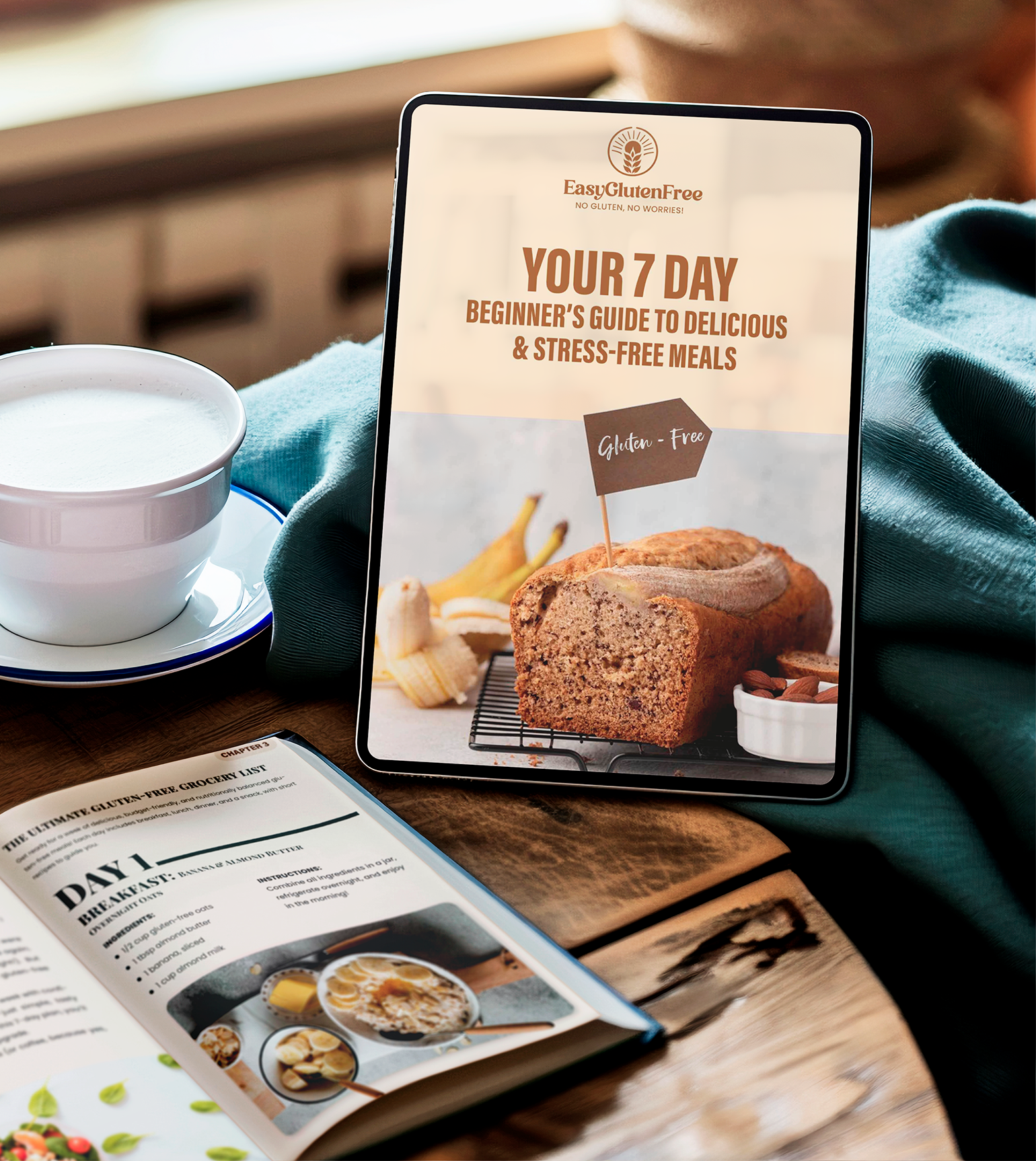
Download the Free Guide to Confident Gluten-Free Testing

How to Test Food for Gluten Safely: Practical Tips, Tools & Travel Strategies
Wondering how to really know if your food is gluten-free—beyond a server’s shrug or a “should be fine” label? This guide walks you through smart, practical ways to test food for gluten at home, eating out, and on the go, so you can eat with more confidence and fewer surprises.
Download Our Free Gluten-Free Starter Guide
- 7-day meal plan
- shopping list
- Tips & 3 beginner-friendly recipes
Introduction
Living gluten-free in 2025 means we have more options than ever before—more products, more “gluten-friendly” menus, and more awareness. But here’s the catch: more options don’t always mean more safety. Cross-contact, vague labels, and well-meaning but misinformed staff can still leave you wondering, “Is this really safe for me?”
That’s where learning how to test food for gluten comes in. Whether you have celiac disease, non-celiac gluten sensitivity, or you simply feel better avoiding gluten, having a strategy—and sometimes tools—to check your food can reduce anxiety and help you enjoy meals again. Think of this guide as your friendly, practical companion: no scare tactics, just clear steps and realistic expectations.
In this article, we’ll cover how gluten testing works, where it fits into a safe gluten-free lifestyle, and how to pair technology with old-school common sense. You’ll learn about test limitations, smart restaurant strategies, label-reading skills, and when a portable gluten test can add an extra layer of peace of mind—especially when you’re traveling or trying something new.
1. Understanding How Gluten Testing Works
Before you rely on any test—high-tech gadget or old-fashioned label—it helps to understand what we’re actually looking for. “Gluten” isn’t a single, tidy ingredient. It’s a group of proteins found in wheat, barley, rye, and hybrids like triticale. Many tests are designed to detect specific gluten fractions (often gliadin), and each has its own strengths and limitations.
Most modern gluten tests, whether in a lab or in your hand, are built around antibody-based technology. They use antibodies that bind to gluten proteins and produce a signal if gluten is present above a certain threshold. That threshold is important: many tests are geared around the 20 parts per million (ppm) standard that defines “gluten-free” labeling in several countries. A result doesn’t mean “zero gluten”—it usually means “below the test’s detection limit.”
When testing food, a sample is taken from the dish, mixed with a special solution, and then exposed to the test device or strip. If gluten is detected, you’ll see a positive result; if it’s below the detection limit or not present, you’ll see a negative result. Sounds simple, but real life is messier: gluten can be unevenly distributed in a dish, some ingredients may interfere with the test, and certain foods (like very fermented or hydrolyzed products) are harder to measure accurately.
This is why experts suggest treating gluten tests as one tool in the toolbox, not your entire safety strategy. Testing bites of food can be incredibly empowering, especially in unknown settings, but it doesn’t replace good kitchen practices, clear labeling, or honest communication from restaurants. Think of testing as a way to reduce uncertainty—not to grant 100% guarantees.
It’s also important to separate two concepts: testing food and testing your body. Food tests aim to detect gluten before you eat. Lab-based blood work, biopsies, or symptom tracking look at how your body responds after exposure. In day-to-day life, most of us want to catch problems before they reach the plate, which is where portable testing tools, label-reading, and safe habits all work together.
2. Portable Gluten Testing Tools & When to Use Them
Portable gluten-test devices have changed the way many people approach eating out, traveling, and even potlucks. Instead of relying solely on verbal assurances, you can test a sample of your food on the spot and get a result within minutes. For some, that extra data alone is worth carrying a small device in their bag.
These tools are especially helpful in “gray area” situations: a new restaurant that claims to be gluten-aware, a shared kitchen where you’re worried about cross-contact, or a food that seems safe on paper but still makes you uneasy. They’re also useful when you’re doing a bit of personal research—such as learning which cuisines, dishes, or brands tend to work best for your body over time.
It’s crucial, though, to understand what on-the-go testing can and cannot do. A negative test doesn’t promise a reaction-free experience; it means gluten was not detected in the specific piece of food you tested, at the threshold of that device. A positive test is often more clear: it’s your cue to skip that dish and, if possible, discuss what might have gone wrong in preparation. Used thoughtfully, portable testing can help you fine-tune your choices and advocate for yourself with more confidence.
Many people reserve these tests for higher-risk scenarios—like group events, travel days, or the first time trying a new restaurant. At familiar places with strong protocols and dishes you’ve tolerated well, you may decide testing every item isn’t worth the cost or time. There’s no single “right” approach; it’s about using tools in a way that supports your anxiety level, budget, and health needs.
Always pair portable testing with your other safety habits: double-checking ingredients, confirming dedicated prep areas, and staying aware of your own symptom patterns. Technology is powerful, but your lived experience and boundaries are just as important.
Nima gluten sensor test
These single-use capsules pair with the Nima Sensor to help users test foods for gluten on the spot. Perfect for travelers, researchers of their own digestive reactions, or anyone who just doesn’t trust that café’s “gluten-free… we think?” answer. A reliable, quick-gluten-detection option that empowers people who want data—not guesswork.

3. How to “Test” for Gluten Without Gadgets: Labels, Kitchens & Questions
Even if you never use a portable gluten test, you can still effectively “test” your food using three powerful tools: labels, kitchens, and questions. These won’t give you a numeric ppm reading, but they do help you stack the odds in your favor every single day.
1. Mastering gluten-free label reading
Start by looking for any clear gluten-free statement. In many regions, a “gluten-free” label means the product must meet specific standards—often under 20 ppm and produced in a controlled way. From there, read the full ingredient list, not just the front of the package. Scan for wheat, barley, rye, malt, and brewer’s yeast, as well as less obvious sources like couscous, farro, spelt, and seitan.
Next, check for allergen statements. “Contains wheat” is a clear no. “May contain wheat” or “Made in a facility that also processes wheat” doesn’t automatically mean the product will be unsafe for every person, but it is a red flag if you are highly sensitive or strictly avoiding even trace gluten. Over time, you’ll develop a shortlist of brands and certifications you trust.
2. Evaluating kitchens for cross-contact
A naturally gluten-free food can still cause problems if it’s prepared in a gluten-heavy environment. In your own kitchen, aim for separate gluten-free zones: dedicated toaster, cutting board, colander, and wooden utensils are smart starting points. Wipe surfaces carefully, wash hands between tasks, and keep gluten-free items stored and labeled clearly.
In someone else’s kitchen, a little observation goes a long way. Is gluten-free pasta drained in the same colander as wheat pasta? Is your salad cut on the same board used for regular bread? You don’t have to become a kitchen detective, but it’s absolutely okay to ask how your food will be prepared and to offer simple suggestions when appropriate.
3. Asking targeted, low-stress questions
How you ask questions often matters as much as what you ask. Instead of simply saying, “Is this gluten-free?” try more specific prompts like:
- “Does this dish contain wheat, barley, rye, or malt?”
- “Is there a dedicated gluten-free fryer, or is everything fried together?”
- “Is the sauce or marinade made in-house, and does it use flour or soy sauce?”
- “Can you prepare this on a clean pan with no bread or flour used before it?”
These kinds of questions gently “test” the restaurant’s systems and knowledge. If staff can answer confidently and explain their process, that’s reassuring. If they look unsure or say things like “we scrape the crumbs off,” that’s your cue to step back and reassess.
Using labels, kitchen awareness, and smart questions together can dramatically lower your risk—sometimes even more than a single device can. Best of all, these habits are free, repeatable, and work anywhere in the world, Wi-Fi or not.
Recipe Inspiration
Try these gluten-free staples loved by thousands:



4. Testing Food for Gluten When Eating Out or Traveling
Restaurants and travel days are where gluten-safety skills really get stress-tested. The good news: with a simple framework, you can dramatically lower your risk and feel more in control, even when you’re far from your own kitchen.
Step 1: Do a quick pre-check
Before you go, look up the restaurant online. Check for:
- A dedicated gluten-free menu or clearly marked gluten-free items
- Any mention of shared fryers, shared ovens, or limitations
- Reviews from gluten-free or celiac diners describing their experience
This “pre-test” helps you filter out spots that clearly aren’t a fit and focus on those more likely to understand your needs.
Step 2: Have a short script ready
When you arrive, let your server know up front, in a calm, clear sentence, what you need. For example: “I need to avoid gluten, including cross-contact with wheat, barley, and rye. Can you help me choose the safest options?” This invites partnership instead of confrontation and sets expectations from the start.
Step 3: Test high-risk items (if you use a device)
If you carry a portable gluten test, you might choose to use it on:
- Sauces, gravies, or soups where ingredients aren’t obvious
- Fried foods that may share oil with breaded items
- Dishes with croutons, breadcrumbs, or tortillas removed “after the fact”
- Anything that feels like a gamble, even if it’s marked gluten-free
Take a small sample from different parts of the dish if you can—especially for mixed foods like casseroles or salads with toppings. If you get a positive result, it’s okay to politely send the dish back and explain why. You’re not being difficult; you’re protecting your health.
Step 4: Have a backup plan
Sometimes, despite your best efforts, a restaurant just doesn’t feel safe. That’s when backup snacks, simple foods (like fruit, nuts, or individually packaged gluten-free items), and a flexible mindset are life savers. On travel days, it’s wise to assume you’ll need at least one meal or snack that comes entirely from your own bag.
Step 5: Use patterns to refine future choices
As you gain experience, you’ll start noticing patterns: cuisines that tend to be easier (like naturally gluten-free Latin American or certain Mediterranean dishes), chains that are better trained, or local spots that consistently take you seriously. Keeping a simple list in your phone—“safe places,” “maybe,” and “not worth it”—helps you quickly choose better options next time.
The goal isn’t perfection; it’s learning what combination of questions, tools, and boundaries makes you feel safest while still allowing you to enjoy food and experiences along the way.
5. Building Your Personal Gluten-Safety Routine
Sustainable gluten-free living is less about one dramatic test and more about small, repeatable habits that become second nature. When you build a simple routine that works for your life, decisions get easier and your brain gets a break from constant food-anxiety mode.
Start with your “non-negotiables”
Write down what absolutely must be in place for you to feel safe. For some, that includes only eating certified gluten-free grains, using dedicated cookware at home, and avoiding shared fryers entirely. For others, the line might be different. Clarity helps you make faster decisions and communicate your needs consistently.
Decide when you’ll use testing tools
If you use a portable gluten test, define a few default rules, such as:
- “I’ll test the first time I eat at any new restaurant.”
- “I’ll test items that come from shared fryers or complex sauces.”
- “I won’t test every single meal at my trusted regular spots.”
Having these guidelines ahead of time prevents decision fatigue and helps you save tests for when they matter most to you.
Create a simple home system
At home, build a routine around:
- Keeping a short list of trusted brands for staples like oats, bread, pasta, and snacks
- Labeling shelves or bins as “gluten-free only”
- Doing a quick label re-check whenever packaging changes
- Teaching family or roommates how to avoid cross-contact
Once everyone in your household knows the system, you’ll spend less time policing crumbs and more time actually enjoying your meals.
Listen to your own patterns
Every body is different. Some people react strongly to trace gluten; others notice symptoms only after larger exposures. Keeping a loose food and symptom log—especially during the first months gluten-free or after big changes—can help you connect dots. Use what you learn to fine-tune how strict you want to be in restaurants, travel, or shared kitchens.
Give yourself permission to adjust over time
Your comfort level with testing, dining out, and risk may shift as you gain confidence. Early on, you might test more often and stick to a small circle of trusted foods and restaurants. Later, you may feel comfortable loosening up slightly—or you may choose to become stricter, depending on how your body responds. There’s no prize for being the most relaxed or the most rigid; there’s only what feels sustainable and safe for you.
At the end of the day, testing food for gluten is about reclaiming a sense of control. By combining smart habits, clear communication, and (if you choose) targeted use of portable tests, you can build a gluten-free lifestyle that protects your health without completely taking over your life.
Key Takeaways
- Gluten tests detect specific proteins above a set threshold, so results reduce uncertainty but don’t guarantee a completely gluten-free meal.
- Portable gluten testing tools are most helpful in higher-risk situations like new restaurants, travel, or shared kitchens.
- Label-reading skills, kitchen awareness, and targeted questions are powerful ways to “test” your food without any gadgets.
- When eating out, combine pre-visit research, clear communication, and, if desired, spot testing to build safer, more confident choices.
- A personal gluten-safety routine—grounded in your non-negotiables and your body’s patterns—helps make gluten-free living more sustainable and less stressful.
Take the Next Step in Your Gluten-Free Journey
- Download the Free EGF Starter Guide
- Try our Gluten-Free Planner to simplify your week
- Explore our growing recipe library
You don’t have to navigate the gluten-free lifestyle alone, we are here to make it easier every day.
Category: Gluten-Free Lifestyle